This article on How to Open a Futures Trading Account is the opinion of Optimus Futures.
Opening a futures trading account is more involved than opening a stock brokerage account, and the differences catch most new traders off guard. Futures are leveraged instruments traded on regulated exchanges, so the application process includes regulatory disclosures, margin agreements, and clearing relationships that don’t exist in standard equity accounts. None of it is complicated once you know what’s coming.
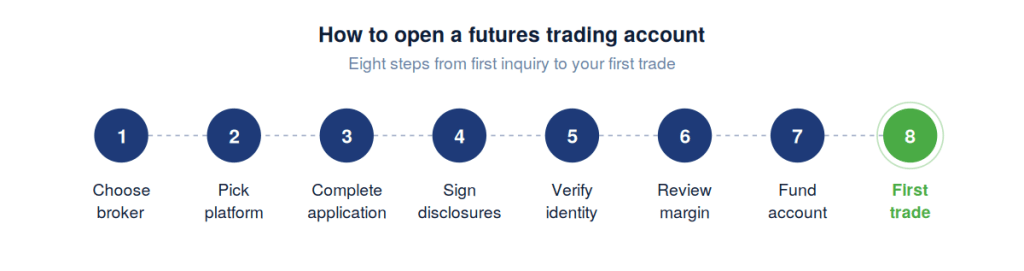
This guide walks through each of the eight steps — from choosing a broker to placing your first trade — including what documents you’ll need, how margin and clearing work, and what to expect before your account goes live.
Who this guide is for: New traders opening their first futures account, active stock traders exploring leveraged products, and traders moving from prop firms to a retail account. If you’ve never placed a futures trade before, you may want to start with our ultimate beginner’s guide to trading futures and come back here when you’re ready to open an account. If you already trade futures and want platform or margin specifics, jump to Step 2 or Step 6.
Quick answers
- How long does it take? 15–30 minutes to apply, 1–2 business days for identity verification, 24–48 hours for funding via wire.
- How much money do I need? Day trading E-mini S&P 500 futures typically requires $500–$1,000 of intraday margin per contract. Micro contracts lower the threshold significantly.
- What documents do I need? Government ID (driver’s license or passport) and proof of address dated within 90 days.
- Is my money safe? Customer funds are held in segregated accounts at the clearing FCM under CFTC Regulation 1.20, separate from the firm’s operating capital.
What is a futures trading account?
A futures trading account is a brokerage account approved to trade standardized futures contracts on regulated exchanges such as CME Group, CBOT, NYMEX, or COMEX. Unlike a stock margin account, a futures account operates under a different margin system, set by exchange minimums, and is cleared through a Futures Commission Merchant (FCM).
Step 1: How to Choose a Futures Broker
Your first decision is selecting a broker — and in the futures industry, broker structure matters. There are two primary types:
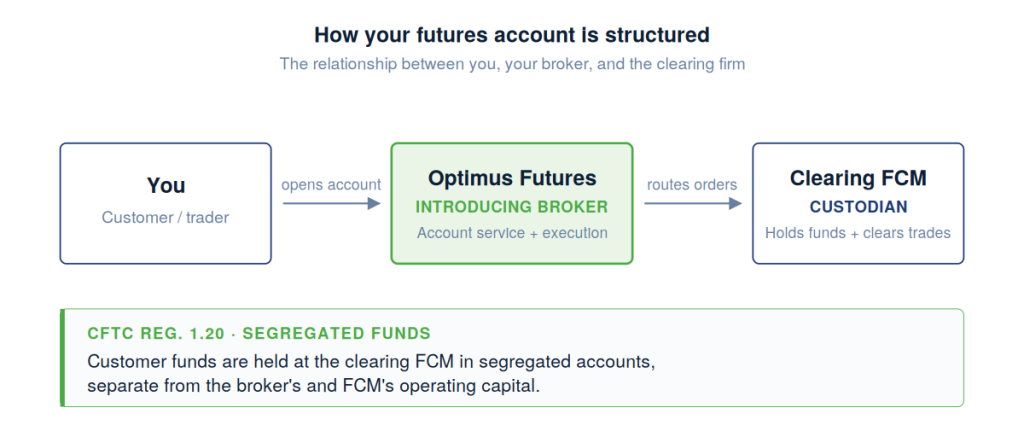
- Futures Commission Merchants (FCMs) maintain custody of customer funds and clear trades internally. They are registered with the CFTC and are members of the NFA.
- Introducing Brokers (IBs) bring client accounts to a clearing FCM without holding customer funds. IBs are also CFTC-registered and NFA-member firms, and they may offer more personalized service and platform flexibility than large FCMs. Independent Brokers (IIB) such as Optimus Futures provide access to multiple FCMs.
Optimus Futures meets each of these criteria: NFA-member, CFTC-registered introducing broker; multiple clearing FCM relationships; support for all major platforms and data feeds; published commission and margin schedules; and a live trade desk accessible during full trading hours.
What to Look for When Choosing a Futures Broker
- CFTC registration and NFA membership — verify any broker at the NFA BASIC system
- The clearing firm(s) they use
- Platform options and data feed providers — which feeds does the broker support? (Rithmic, CQG)
- Margin rates and commission structure
- Accessibility of the trade desk, particularly during market hours
Step 2: Select a Futures Trading Platform
Choose your trading platform before or during your account application — the right choice depends on your trading style, and your broker should support multiple options.
Futures Trading Platforms Supported by Optimus Futures
- Optimus Flow — proprietary platform, powered by Rithmic data
- TradingView — web-based charting and order execution
- Quantower — advanced DOM trading, multi-account support
- Sierra Chart — preferred by serious intraday and algorithmic traders
- CQG Desktop — institutional-grade data and execution
- Deepcharts – Web-based order flow and volume trading
Your choice of platform will affect data feed costs and available margin rates. Most platforms offer a free trial worth using before committing. Remember: the trading platform is a third-party technology provider, independent of both your broker and the exchange — an important distinction if you ever encounter a display issue or connectivity problem.
Step 3: Complete the Futures Account Application (What Information You’ll Need)
The futures account application is more detailed than most brokerage applications because it collects the information required by NFA compliance rules and the clearing FCM.
What Information Is Required to Open a Futures Account
You will usually be asked for: full legal name, address, birthdate, and Social Security Number (or Tax ID), employment status and employer, annual income, net worth, liquid net worth, trading experience, and investment objective (speculation, hedging, or both).
Why futures applications ask about experience and finances: Futures trading involves leverage and the potential for losses exceeding your initial deposit. NFA rules require brokers to collect this information to assess suitability. There is no universal minimum income or experience requirement, but the information you provide should be accurate — it informs the clearing firm’s risk assessment and your account’s margin parameters.
Step 4: Review and Sign the Required Regulatory Disclosures
You’ll be sent regulatory disclosure documents to read and sign before your account is approved. These are not boilerplate to scroll past — they contain information directly relevant to how your account operates.
Key Regulatory Documents in a Futures Account Application
- Risk Disclosure Statement — per CFTC Reg. 1.55; describes the risk of losing more than your initial deposit. Read it.
- Account Agreement — governs the relationship between you and the broker; includes provisions about margin calls, liquidation rights, and statement review obligations.
- Customer Identification Program (CIP) Notice — required under federal anti-money laundering rules; confirms your identity will be verified.
One provision requires particular attention: review your daily statements promptly and report any discrepancies in writing to the clearing firm within a specified period. This is a contractual obligation, not advisory guidance. The official statement is the definitive record of your account activity — not the information displayed on your trading platform.
Step 5: Submit Identity Verification Documents
The Customer Identification Program (CIP) is a federal requirement under the USA PATRIOT Act. Your broker must verify your identity before approving your account.
Identity Documents Required to Open a Futures Account
- Government-issued photo ID — either a driver’s license or passport
- Proof of address — utility bill, cable, internet, phone bill, mortgage, or full rental lease dated within the last 90 days
For entity accounts (LLCs, corporations, trusts), additional documentation is required including formation documents, EIN, and identification for controlling persons. Document review typically takes one to two business days. Make sure your ID is current and that your address on the application matches your proof of address exactly.
After approval, treat your login credentials like your bank details. Don’t share them with anyone — including third-party trading services or advisors — without a written agreement in place.
Step 6: Understand Futures Margin Requirements Before You Fund
What is futures margin? Futures margin is a performance bond — a good-faith deposit that keeps an open position active. Unlike a down payment or a loan, it functions as a guarantee of performance rather than financing the trade.
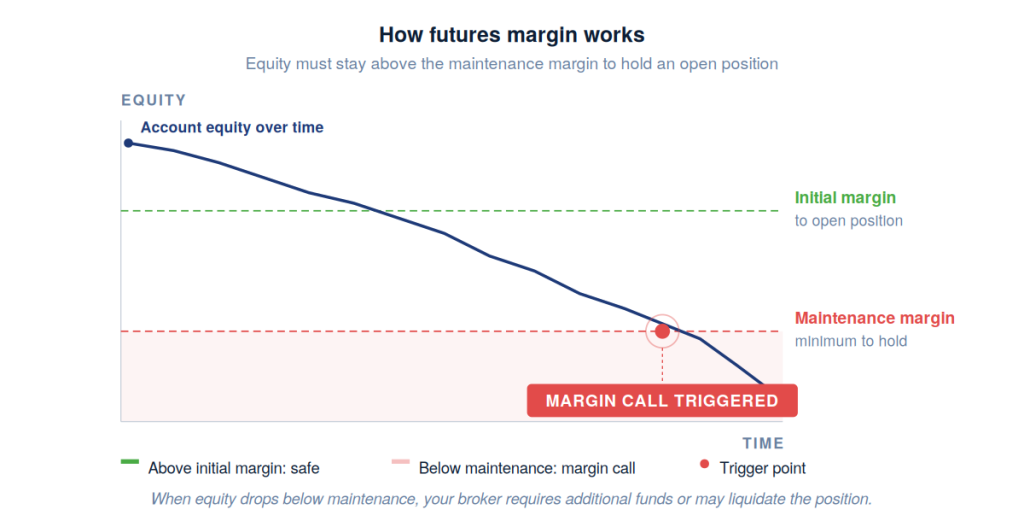
Initial margin is the amount required to open a position. Maintenance margin is the minimum balance required to hold it. If your account equity falls below the maintenance threshold, you will receive a margin call.
Initial Margin, Maintenance Margin, and Intraday Margin Explained
- Initial margin — set by the exchange and varies by contract and market volatility
- Maintenance margin — the minimum balance required to maintain a position; if your equity falls below this level, you’ll receive a margin call
- Intraday margin — set by the broker at a significant discount to overnight margin; applies only within the broker’s defined day trading hours. Optimus Futures day trading hours run from [6:00] PM ET through [4:45] PM ET the following day. If you hold an open position past [4:45] PM ET, the broker will attempt to liquidate that position. Confirm your broker’s specific day trading window before you trade.
- Margin calls — require you to deposit additional funds or reduce open positions; failure to respond gives your broker the right to attempt liquidation
Optimus Futures publishes day trading margin schedules for every major contract here. Overnight margin follows the minimums set by the exchange and clearing FCM.
Fund your account with capital you can afford to lose. Starting with more than the minimum margin requirement gives you room to manage positions without being immediately vulnerable to a margin call on a normal intraday move.
Note: During high volatility,
Step 7: Fund Your Futures Trading Account
After approval and identity verification, you’ll fund your account. Common methods include:
Futures Account Funding Methods
- ACH transfer — standard bank transfer, typically 2–3 business days
- Wire transfer — fastest method, typically same-day if sent before the cutoff; fees vary by bank
- Debit card or Apple/Google Pay — available through select clearing firms; not all FCMs carry this option, so confirm with your broker before assuming it is available
- Check — accepted by most brokers but slower to process
Important: Futures account funds are held at the clearing FCM level, segregated from the firm’s own operating capital under CFTC Regulation 1.20. This is a regulatory requirement — customer funds cannot be used for the broker’s operational expenses or proprietary trading.
Step 8: Configure Your Platform and Place Your First Futures Trade
Pre-Trade Setup Checklist for New Futures Traders
- Verify your account connection — confirm your platform is linked to your live account, not a demo environment.
- Set up your workspace — charts, order entry, DOM (Depth of Market), and position/P&L windows.
- Understand your order types — know how to place a market order, limit order, and stop order; understand how OCO (One-Cancels-the-Other) orders work for bracketing positions.
- Know your platform’s disconnect behavior — if you lose connectivity, does the platform cancel working orders or leave them active? Know this before you are in a live position.
- Save your broker’s trade desk number — if your platform goes down during a live position, the trade desk is your direct line. For Optimus Futures: 1-800-771-6748. Local 561-367-8686.
- Limit your first live trade to micro contracts — Micro E-mini S&P 500, Micro Gold, and similar instruments provide real-market exposure at a fraction of standard contract margin. For guidance on sizing and managing a first trade, see our risk management guide.
Frequently Asked Questions About Opening a Futures Account
The application takes 15–30 minutes. Identity verification typically takes one to two business days. Wire transfer funding can have your account ready within 24–48 hours of completing the application. ACH transfers add two to three business days.
Minimums depend on the contract and your trading strategy. Day trading E-mini S&P 500 futures usually needs $500–$1,000 of intraday margin per contract, but trading comfortably — with room for normal drawdown — means starting with significantly more. Micro contracts may significantly lower the capital threshold.
Futures margin is a performance bond, not a loan. You are not borrowing money to buy an asset — you are posting collateral to hold a leveraged contract. Futures accounts also have different tax treatment (see Section 1256, 60/40 rule) and are regulated by the CFTC and NFA rather than FINRA and the SEC.
If your account equity falls below the maintenance margin level, your broker will notify you that additional funds are required. If you do not deposit funds promptly, your broker has the right to attempt to liquidate open positions to bring your account back into compliance with margin requirements. The timing and method of liquidation are governed by your account agreement.
Yes. You can establish a futures account under an LLC or corporate entity, though it requires more time and additional documentation — articles of organization or incorporation, an EIN, and identification for beneficial owners. The account functions identically to an individual account once approved.
FCMs act as custodians of client funds and clear trades themselves. Introducing brokers bring client accounts to a clearing FCM without holding funds. Both are CFTC-registered and NFA-member firms. In practice, the distinction matters most for understanding where your funds are held — at the clearing FCM — and who handles trade execution and customer service — your introducing broker.
Ready to Open a Futures Trading Account?
If you’re ready to open an account with Optimus Futures, the application takes about 15 minutes. We’re available by phone during trading hours to help with platform setup, margin questions, or anything else before you fund.
OPEN LIVE ACCOUNTNot ready to open an account? Browse our Futures Trading Learning Center for guides on contracts, order types, margin, and trading strategies.
Trading futures carries a substantial risk of financial loss, making it unsuitable for some investors. Past performance is not indicative of future results.
Optimus Futures, LLC is an NFA member and CFTC-registered Introducing Broker.