Many stock traders and investors start the day the same way: before the opening bell, they check futures to get a sense of where the market may be headed. If a financial TV channel says “S&P futures are up 0.4%,” that usually sounds bullish. If, on the otehr hand, futures are down sharply, they brace for a weaker open.
But the market has a way of humbling simple readings like that.
What does that number actually tell you?
For those who focus mainly on stocks and ETFs, ES futures can feel both familiar and mysterious. You may know they are tied to the S&P 500, but you might not exactly know why futures move overnight, how reliable the opening numbers are, or what you’re supposed to do with that information.
The data holds quite a lot because ES futures trade nearly around the clock. By the time the stock market opens at 9:30 a.m. ET, futures traders around the world have already spent hours reacting to economic data, overseas markets, earnings releases, and breaking news.
For stock traders, ES futures are more than just background noise. They offer an early read on sentiment, reveal where pressure is building, and provide useful context before your first trade. Platforms such as Optimus Web and Optimus Flow make that overnight activity easier to visualize, especially when you want to see how the market got from yesterday’s close to this morning’s setup.
What are ES futures, and how do they relate to the stock market?
ES futures are contracts that track the S&P 500 index and trade nearly 24 hours a day.
So, by the time the bell rings, part of the story has already been told. That’s the assumption.
Traders use the ES to gauge where the stock market may head, even before U.S. exchanges open for trading. Think of ES as the tradable version of the S&P 500 that keeps moving even when the stock market is closed, unlike its ETF equivalent, SPY.
While everyone’s getting ready for the opening bell, traders are responding to the overnight verdict that has already formed, like a market proposition that U.S. traders will either accept or reject.
From a bigger picture perspective, market participants in Europe and Asia have adjusted their positions in anticipation of the U.S. trading sessions. The SPY is about to open, but the ES is already moving.
Here is a simple comparison:
| Features | ES | SPY |
| What it tracks | S&P 500 | S&P 500 |
| Where it trades | Futures exchange | Stock exchange |
| Trading hours | Nearly 24 hours | Regular and extended stocks hours |
| Common use | Speculation, hedging, price discovery | Short to long-term trading/investing |
READ ALSO | Futures VS Stocks
You’re probably wondering—what is price discovery?
Here’s something important to note: ES futures often become the market’s first place to react when something happens outside regular stock market hours.
That’s why many traders look at ES before they place trades in any asset that’s correlated to the broader market (and to a certain degree, that’s nearly all commonly-traded assets).
Why do ES futures move overnight when the stock market is closed?
The S&P 500 is arguably one of the most important benchmarks in the world. The ES can easily be influenced by global markets and macroeconomic news. Furthermore, institutional trading continues even while the U.S. equities markets are closed.
ES futures trade on the Globex session, which runs almost continuously from Sunday evening through Friday afternoon, with only brief daily pauses.
So if something important happens at 2 a.m., 5 a.m., or 8:30 a.m., if a major economic report comes out before the opening bell, if Europe sells off sharply, or if geopolitical headlines change the risk outlook, you’re likely to see a reaction in the ES.
Here are a few common reasons why overnight moves happen:
1 – Global markets are open
When Asian and European markets begin trading, central bank comments and other geopolitical developments often spill over into U.S. index futures if U.S. markets are correlated with those international markets. For example, if the DAX sells off hard, ES rarely ignores it.
2 – Economic data often hits before 9:30 a.m.
Reports such as CPI, nonfarm payrolls, PPI, GDP, and retail sales often come out before the stock market opens. Futures traders do not wait for the bell. They begin pricing in the news immediately.
3 – Institutions use futures to adjust exposure.
Large funds, hedge funds, and macro traders use ES futures because they are fast and liquid. If they want to reduce risk or add exposure before the stock market opens, futures are often the most efficient way to do it. So, guess which asset gets bought or sold first? The ES is the quickest way to move size.
4 – Earnings and company-specific news can affect the index.
If a large company such as Apple, Microsoft, or NVIDIA reports earnings or issues guidance before the open, that can move ES futures because those stocks carry significant weight in the index. The index almost always moves with the largest names.
In other words, by the time a stock trader sits down at 9:00 a.m., the global reaction has already attempted to price in the current developments using the ES futures.
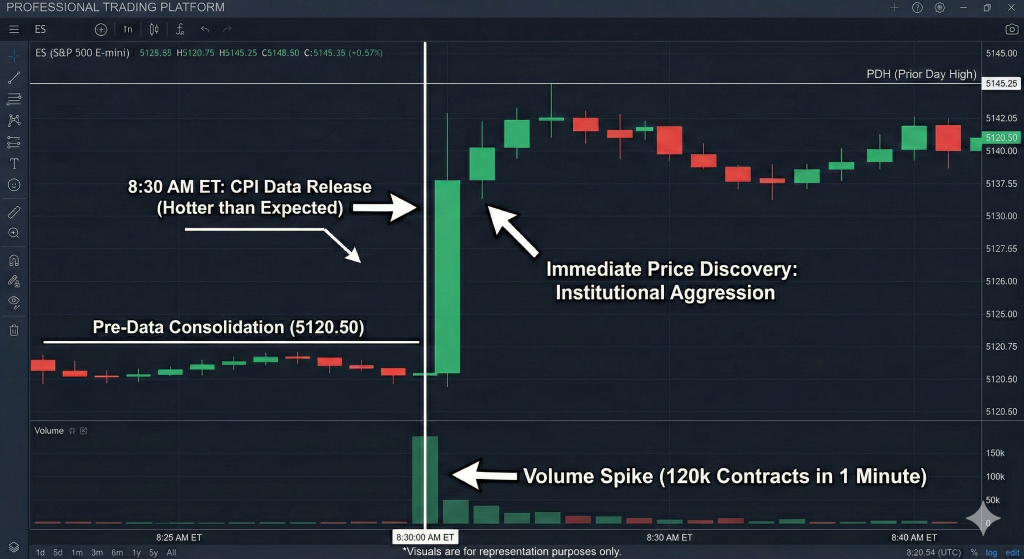
Caption: An overnight ES chart can show where sentiment changed before the U.S. open, often in response to overseas market action or pre-market news.
See for yourself: using Optimus Web or Optimus Flow, you can often see when the move started, whether it happened all at once or in stages, and whether the market is holding those gains or losses into the open. For stock traders, this can provide extremely useful context before trading SPY, QQQ, or individual large-cap names.
Do ES futures always predict where stocks will open?
ES futures often provide a strong indication of where stocks will open, but they do not always predict the exact opening direction.
However, it does give you the advantage to prepare for different scenarios based on the current market sentiment.
If the ES futures are up several points before the open, pay attention. The broader market sentiment may be exceedingly bullish. If they are down sharply, a bearish follow-through may occur. What you’re seeing is likely the global and/or institutional “pricing in” of the broader market based on currently-known information.
Nevertheless, the ES is not a predictor.
There are times when ES futures point one way before the bell, only for stocks to reverse and move in the other direction. Sometimes the market opens in line with futures, and then the stocks move sideways. Other times, futures hold up overnight, but a fresh headline right before [9:30] changes the tone and sets the market in a different direction.
So watch out for a few common things that can cause the ES and stock market opening to disconnect:
1 – A major report hits right before the open.
An 8:30 a.m. data release can reprice the market in mere seconds. If you looked at futures at, say, 7:00 a.m., your read on the market may already be outdated.
2 – An important company reports earnings.
A giant company can move index sentiment quickly, especially if it is heavily weighted in the S&P 500 or Nasdaq. Futures may adjust, but stock-specific reactions can create more complexity at the open.
3 – Liquidity can change near the bell.
Overnight futures trading can be thinner than regular trading hours. A price move that looks important at 4:30 a.m. may not hold up once volume increases due to a larger percentage of market participants.
4 – Opening imbalances can change the first few minutes.
The stock market has its own mechanics. Even if the ES does a good job anticipating the direction, the exact opening print and the first 5–15 minutes can be super volatile and noisy.
So the practical answer is this: the ES will give you context. It allows you to plan your trade. But it won’t predict the direction of the broader market. Instead, it’ll help you understand where the market is leaning, but that’s all (yet, that’s plenty.
For stock traders, that distinction matters. A strong ES move before the open should make you pay attention, not assume the outcome is locked in.
Pro Tip: It’s smart to combine futures price action with other technical and fundamental information before the [9:30] open approaches.
What causes a big move in ES futures right before 9:30 a.m.?
News and reports (your short answer). Large moves before the open are usually driven by major economic data, Federal Reserve news, earnings from influential companies, or global risk events.
Pro tip: You can anticipate these volatile reactions by looking at an economic or earnings calendar.
When ES makes a big move before 9:30 a.m., it’s usually because traders are reacting to something that changes expectations quickly. Sometimes that “something” is obvious, like a CPI surprise or a strong jobs report. Other times, it is a combination of factors building overnight.
Here are some of the more common drivers:
Economic reports
Some of the most important economic data releases arrive before the [9:30] open. Think: inflation reports, jobs data, retail sales, and GDP revisions. All can move the ES sharply. All reflect an angle on expectations for growth, interest rates, and overall risk appetite.
For example, if CPI or PPI inflation comes in hotter than expected, traders may assume the Federal Reserve will stay tighter for longer. Even the smallest signal can cause markets to fluctuate, exerting downward pressure on equities before the open. If the data is cooler than expected, futures may jump on hopes of a more accommodative policy.
When there’s consensus, the market moves in a straight line. When there isn’t, it chops.
Federal Reserve headlines
Fed speeches and comments, if done before the bell as is the case when they’re delivered in a different country and time zone, can shift rate expectations, moving markets quickly.
A single comment from a Fed official can change how traders interpret monetary policy—even when no decision is scheduled.
The market listens closely. Sometimes too closely. And sometimes, what’s “said” will be interpreted differently from one trader to another.
Nevertheless, by the time investors notice the move in the index, futures have usually reacted first.
Earnings from large-cap companies
A single company won’t move the entire market. A large one can.
When Apple, Microsoft, Amazon, Meta, or NVIDIA surprises, ES reacts quickly.
The weight of the name often does the work.
So, if you trade tech-heavy stocks or index ETFs, earnings really matter. A sharp move in ES or NQ at 7:00 a.m. usually means sentiment has already shifted before the bell. Time to pay attention.
Geopolitical or macro risk
Wars, energy shocks, political instability, sanctions, and other global developments can all move futures overnight. Many traders don’t always watch this. Still, they see the effect it has on the ES.
With that said, it’s important to be aware of the geopolitical environment when making trading or investing decisions. Don’t get caught on something you could’ve anticipated had you paid attention.
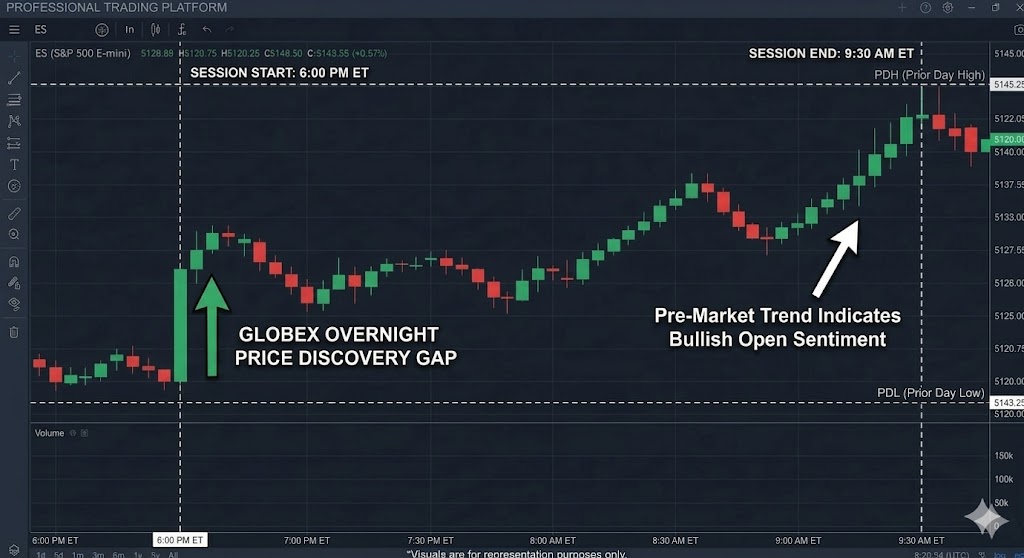
Caption: A sharp pre-market move in ES futures often reflects traders repricing the broader market in response to economic news, Fed commentary, or earnings from major companies.
The key point is this: It’s not enough to see the move. You need to understand what caused it. A move driven by broad participation tends to hold. One driven by a narrow or uncertain catalyst often doesn’t. Know the difference!
How do professional traders use ES futures before the open?
Professionals use ES futures before the open to identify key price levels and prepare a trading plan for the first part of the session.
This is where the ES becomes a practical tool, and not just an informational one. Before the opening bell, many traders are not looking for an abstract prediction. They’re trying to figure out what kind of market is likely to open at [9:30].
More importantly, they’re trying to figure out where the key levels are.
A common pre-market approach includes examining the overnight range, the direction and quality of the move, and support and resistance levels. Traders will also assess momentum and breadth—whether either are strengthening or fading.
Remember: It’s not one signal. It’s the alignment of several.
Take a look at other assets and economic factors, such as Nasdaq futures, Treasury yields, major economic headlines, or reactions in heavily weighted stocks.
On a platform such as Optimus Flow or Optimus Web, that can mean watching charts, key levels, and time-based reactions before the opening bell.
Here’s an example of a pre-open workflow that a trader might use:
1 – Check the larger trend of the ES and assess it against the larger economic fundamentals.
2 – Check the economic calendar to see if any reports are to be released.
3 – Drill down to the S&P sectors.
4 – Check overall breadth using an assortment of breadth and sentiment indicators.
5 – Look at past price action to determine where key support and resistance are located.
6 – Finally, drill down to the stocks or ETFs you intend to trade.
This is just one example of the kind of workflow you might consider using when engaging the markets.
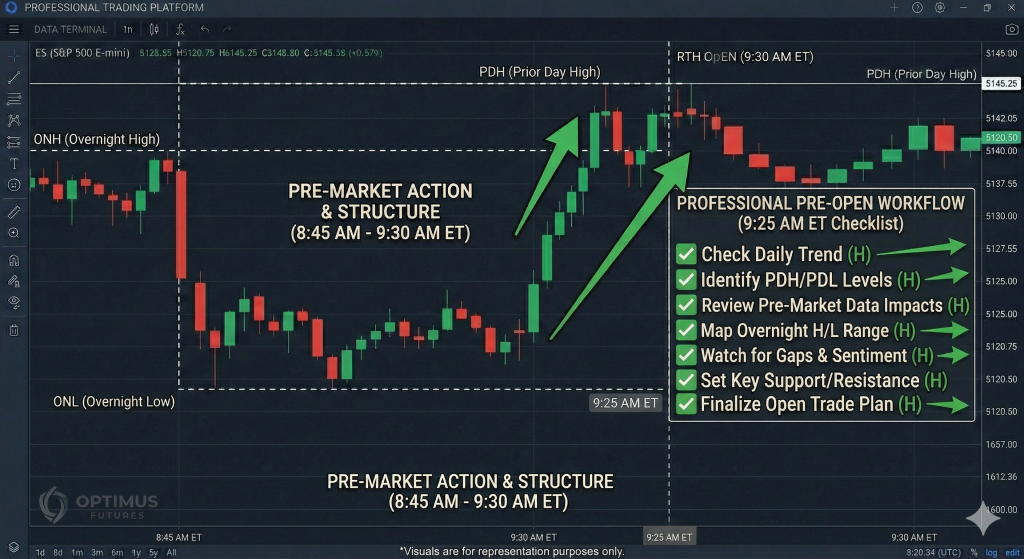
Caption: A pre-market futures setup can help traders identify the overnight range, key price levels, and ESis behavior as the opening bell approaches.
The takeaway is simple: you don’t have to trade futures to benefit from using them as a reference point or benchmark. Even a basic pre-market routine built around ES can improve your read on the opening environment.
Can stock traders use ES futures to improve their timing?
The ES can help, but not in the way many traders think. It won’t predict opening direction, but it’ll tell you the tone of the market. And that’s key to creating your setup and timing your trades.
At best, the ES can help you avoid trading blindly into a market context. Setup and timing are more fragile if you don’t know what’s going on around you.
Let’s go over a couple of ways to do this.
The simplest way to use ES is to compare where it closed the previous session to where it is before the market open. If there was substantial movement, is it holding those gains or losses? Either would suggest market sentiment heading into the session, whether it’s overall bullish or bearish.
Another useful tool is the overnight range. The overnight high and low often become important reference points once regular trading begins. The range gives you key support and resistance levels. Here you can anticipate breakouts.
If the market breaks above the overnight high and holds, that can suggest strength. If it breaks below the overnight low, that can suggest pressure is building.
You can also use ES to add context to trades in SPY, sector ETFs, and highly correlated large-cap stocks. For example, if you are considering a long trade in a big tech name, it helps to know whether ES and NQ are both supporting the broader market tone, or whether the stock is potentially moving against the grain.
This is where charting platforms become useful. Optimus Flow and Optimus Web can help you visualize key pre-market levels, overnight structure, and futures behavior as the open approaches. That does not replace a stock trader’s own setup, but it can provide a broader market framework.
Here’s a practical way to think about it: ES futures help you read the room before the room fills up. You still need a trade plan, but the futures market can tell you whether the opening environment looks calm, nervous, strong, or unstable.
If you want to practice reading futures without jumping straight into a live account, a free demo can be a useful next step for getting comfortable with how ES moves before the bell.
FAQs
ES futures begin trading on Sunday at 6:00 p.m. Eastern Time (ET) and continue almost around the clock through Friday at 5:00 p.m. ET, with only brief daily pauses. The market, in that sense, never really goes quiet—it simply slows.
That schedule also allows traders to react to events as they happen, not just when the stock market is open. By 9:30 a.m., a good portion of the reaction has already taken place. That’s why many look to ES first when trying to understand the tone of the coming session.
Almost everything that matters, economically. It can be daunting if you’ve ever seen a list of global economic releases at once. It’s a huge list.
Breaking it down a bit, global markets, economic reports, earnings, Federal Reserve commentary, geopolitical developments—all of it feeds into futures trading while stocks are closed. Because ES is open, it becomes the first place that reaction appears.
By morning, the market had already begun to express a view. The opening bell doesn’t start the story—it continues it.
When ES is up before the open, it usually suggests that traders are leaning bullish. The move is often tied to something that happened overnight—stronger global markets, favorable data, or a shift in expectations.
But it’s only a read, not a result. The market can agree with that view, or it can change its mind once regular trading begins. Always be ready for either, not just one or the other.
No. They point, but they don’t promise. Futures often give a useful early signal, but again, the picture can change quickly near the bell. All it takes is a new headline, an earnings surprise, or simply the surge of volume at the open as bulls and bears pile in. All of this can alter the direction.
It’s better to think of ES as a “proposition.” The outcome still has to be negotiated and decided.
Because the open is a different market with different traders and different opinions. Overnight, trading can be thinner and more selective. At [9:30], participation expands—institutions step in, orders are matched, and imbalances could potentially be resolved. What looked stable at 7:00 a.m. is suddenly tested.
Some moves hold under that pressure. Others don’t. The open is where the market makes that distinction.
Both track the S&P 500, but they behave differently. ES trades nearly around the clock. It reacts to global flows and overnight developments. SPY, on the other hand, trades during stock market hours and fits more naturally into a traditional equity workflow.
Futures tend to lead overnight. ETFs will either follow or reject its movements. Each has its place, but ultimately, they are not used the same way.
Start with a simple comparison: where did ES close, and where is it now?
If the market has moved overnight, the next question is whether it’s holding. Moves that hold tend to carry more weight; those that fade are often less reliable.
Key levels matter as well. The overnight high and low often act as early reference points once trading begins. Watch for breakouts above these levels.
Again, you’re not trying to predict the open. You’re trying to understand the environment you’re walking into. Is the “room” full of bulls or bears? Do I run with the crowd or go against it? This is what you should be asking yourself.
The bottom line
ES futures matter before 9:30 a.m. because the market doesn’t wait for the opening bell. It has already been reacting—quietly at times, aggressively at others—to global markets, economic data, earnings, and risk events that unfold while most stock traders are off the clock.
By morning, that reaction is no longer hidden. It’s visible in price.
The ES tells you the global market’s opinion. Still, futures are not a crystal ball.
They don’t tell you what will happen—they tell you what the market has already begun to consider; like the market’s proposition.
Look at where ES is trading relative to the prior close, how it behaved overnight, and whether it is holding key levels into the open. It all points to one thing, and thing only: the kind of environment you’re about to step into.
Sometimes the message is clear. Sometimes it can be downright confusing.
If you’re trading index ETFs or large-cap stocks, that distinction matters. ES won’t make the decision for you, but it will tell you whether the ground is steady, shaky, or shifting beneath your feet.
And like anything in markets, familiarity changes everything. The more you watch how ES behaves before the bell, the less those early numbers feel like signals, and the more they read like context.
Platforms like Optimus Flow make that process easier to follow, especially when you want to see how the move developed overnight and where the important levels are forming. And if you’re not yet comfortable reading futures in real time, a demo account is a practical place to begin—before capital is involved, and while the lessons are still inexpensive.
So, what does this all mean? Monitor ES futures and make it part of your daily workflow. The more you observe, the more the market starts to make sense. And the stronger your angle for making smart decisions.
Risk Disclosure: Futures trading involves substantial risk of loss and is not suitable for all investors. Past performance is not necessarily indicative of future results. You should carefully consider whether trading is appropriate for you in light of your financial condition, experience, and risk tolerance.
Start Trading Futures
Ready to put what you’ve learned into action?
Open a live account with Optimus Futures and access professional-grade platforms, real-time data, and dedicated support from day one.
Get Started →
Futures trading involves substantial risk of loss and is not suitable for all investors.